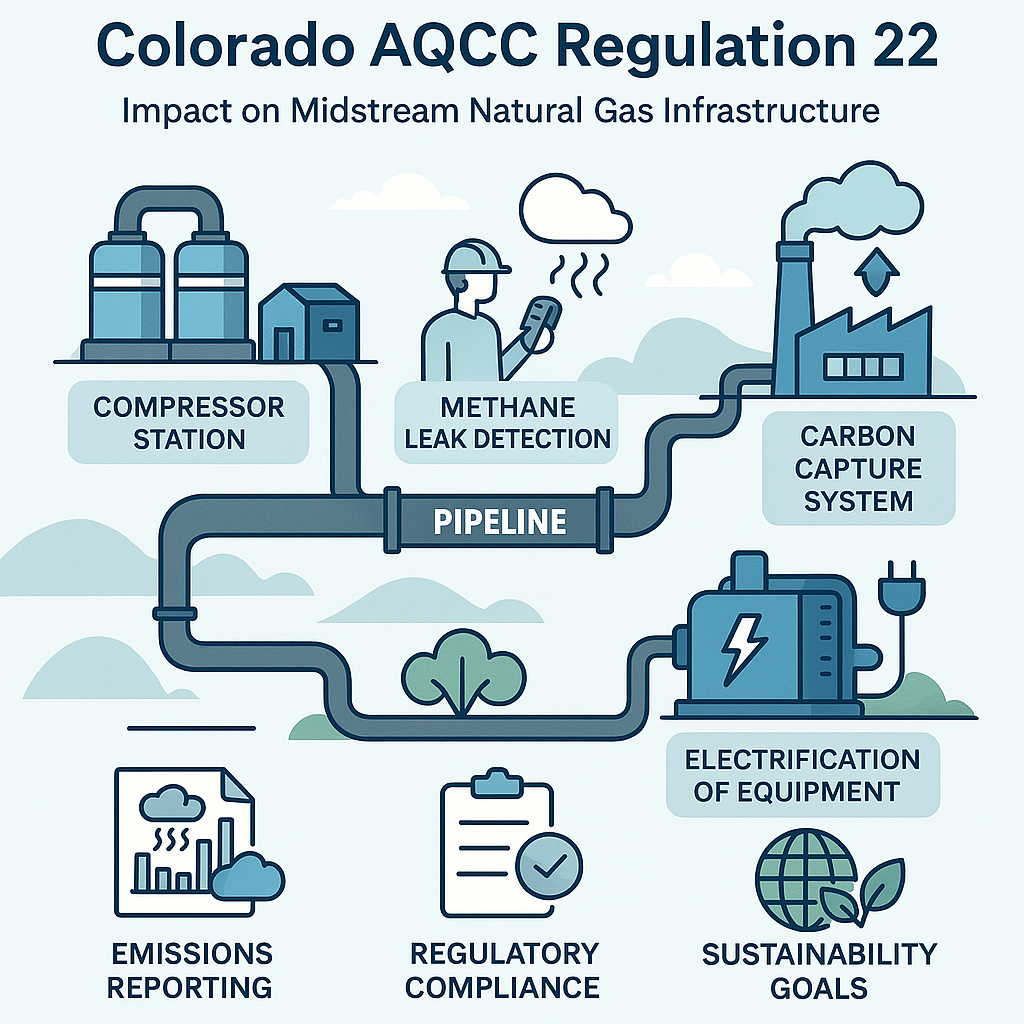
As Colorado increases its efforts to combat climate change, the regulatory landscape for industrial operators (particularly in the natural gas processing plant and gathering system sectors) is evolving rapidly. The latest development, Colorado Air Quality Control Commission (AQCC) Regulation 22, introduces stringent greenhouse gas (GHG) reporting and reduction mandates that will significantly impact how midstream infrastructure is designed, operated, and maintained.
Understanding Regulation 22
Regulation 22, formally titled Colorado Greenhouse Gas Reporting and Emission Reduction Requirements (5 CCR 1001-26), establishes a comprehensive framework for monitoring, reporting, and ultimately reducing GHG emissions across multiple sectors of the state’s economy. For midstream operators (those responsible for gathering systems, natural gas processing plants, and transportation), this regulation will require balancing the development needs of producers and the emissions caps related to GHGs.
The rule mandates that Annual GHG reporting will be required for facilities that emit over 25,000 metric tons of CO₂e per year, as well as multiple sources if they fall below the federal reporting thresholds (e.g., the 25,000 metric ton CO₂e threshold under EPA’s 40 CFR Part 98).
Emission reduction targets are aligned with Colorado’s broader climate goals: a 26% reduction by 2025, 50% by 2030, and 90% by 2050 (from 2005 levels) established under HB 19-1261.
On February 14, 2025, regulatory provisions became effective requiring every midstream company to participate in the emissions reduction program. They must achieve a collective midstream segment cap of 3,930,228 metric tons CO₂e by December 31, 2030, and maintain company-specific caps annually thereafter.
Implications for Midstream Project Development
From a project development perspective, Regulation 22, which was adopted in October 2024 and went into effect in early 2025, requires a paradigm shift. No longer can emissions be an afterthought. GHG emission reduction and methane reduction must be embedded from the earliest stages of project planning.
Here’s what midstream developers will need to consider with their emissions planning:
Carbon Footprint Assessments for New and Existing Assets
Developers must evaluate the lifecycle emissions of both current and planned infrastructure. This includes emissions from:
- Compressors and natural gas processing plants
- Fugitive methane leaks from gathering systems and pipelines
- Combustion sources such as flares and engines
Integrating carbon modeling tools into the front-end engineering design (FEED) process is now essential to determine how overall emissions levels will be impacted for the operator. The company-specific emissions caps are calculated using each operator’s 2021 MFCE GHG emissions. October 2025 will require reporting under this program.
Technology Integration for Emission Reduction at Existing Assets
To meet reduction targets, midstream operators will consider solutions to lower the overall GHG emissions:
- Electrification of engines at compressor stations and natural gas processing plants
- Deployment of low-bleed or zero-bleed pneumatic devices
- Advanced leak detection and repair (LDAR) programs
- Carbon capture and storage (CCS) feasibility for large emitters
Operators will expect to see increased CapEx costs for compliance with marginal increases in processing capacity. Some assets may be consolidated and decommissioned before the planned end of useful life. Client will focus on reducing their methane emissions first, considered 25 times more potent than CO2 emissions. CANUSA EPC has various solutions documented for ideas, check out a novel capture application for Turbine Seal Gas Capture.
Regulatory Compliance Strategy
Operators must establish robust compliance systems that include:
- Real-time emissions monitoring
- Accurate data collection and reporting mechanisms
- Internal audits and third-party verification
Failure to comply could result in penalties and reputational damage, especially as public scrutiny of fossil fuel infrastructure intensifies.
Civil penalties for midstream operators, under C.R.S. § 25-7-122, outline that violators may face civil penalties of up to $47,357 per day, per violation, with the amount adjusted annually for inflation. These penalties apply to a wide range of noncompliance issues, including failure to meet greenhouse gas (GHG) reduction targets, inadequate emissions reporting, and violations of leak detection and repair (LDAR) or combustion control requirements. In severe cases, the Colorado Department of Public Health and Environment (CDPHE) may also seek injunctive relief through the courts to compel compliance or halt operations.
In egregious circumstances (such as willful misconduct, repeated violations, or incidents causing serious harm), operators may also face permit suspension or revocation under C.R.S. § 34-60-121, enforced by the Energy and Carbon Management Commission. While this statute is relevant to upstream operators, it is not directly applicable to midstream GHG violations under Regulation 22 is not clearly defined. These consequences underscore the importance of strict regulatory compliance, accurate emissions tracking, and timely communication with regulators.
Looking Ahead for Natural Gas Processing Plants
Colorado’s Regulation 22 is not just a regulatory hurdle—it’s a signal of the energy transition underway. For midstream operators, aligning with these mandates is not only about compliance but also about future-proofing assets and maintaining social license to operate.
CANUSA EPC’s Role in Supporting Emissions Reductions
At CANUSA EPC, we understand the complexities of midstream development in a carbon-constrained world. Our multidisciplinary teams are equipped to:
- Conduct GHG impact assessments
- Design low-emission natural gas processing plants
- Integrate carbon capture and methane reduction technologies
- Engineer and plan electrical system upgrades
Have any questions or concerns?
Reach out to our team or start a free Class V estimate today to evaluate pathways to low-cost compliance for lower emission operations.
Author(s)
Forrest Churchill
External Sources:
https://www.sos.state.co.us/CCR/GenerateRulePdf.do?ruleVersionId=11724&fileName=5%20CCR%201001-26
https://www.sos.state.co.us/CCR/GenerateRulePdf.do?ruleVersionId=12032&fileName=5%20CCR%201001-9
https://cdphe.colorado.gov/changes-to-colorados-greenhouse-gas-reporting-requirements
https://leg.colorado.gov/bills/HB19-1261
https://www.sos.state.co.us/CCR/GenerateRulePdf.do?ruleVersionId=11843&fileName=5%20CCR%201001-9